

Why Teleoperation Is The Fast-Track To Industrial Autonomy
By Maryam Bandari, Teleoperation and Data Collection Team Lead at Persona AI
At Persona AI, we don’t hide the human behind the curtain…
…We view teleoperation as the fastest, most pragmatic foundation for real-world industrial autonomy. Just as surgical robotics proved decades ago, keeping a skilled human in command isn’t a workaround. It is how you operate safely in an unpredictable environment. Our on-robot machine learning handles the physical dirty work, independently managing balance, joint planning, and footing, while operators use immersive motion capture and low-latency XR to work as naturally as if the machine were their own body. By deploying capable humanoids into real brownfield shops now rather than waiting on full autonomy, we solve high-stakes problems immediately while capturing the expert task data needed to systematically automate those workflows tomorrow.
A human in a headset welding in a live shop today, fast-tracks autonomy tomorrow
We recently took our humanoid out of the lab and into a live shop at ARC Specialties in Houston, a leader in custom welding automation, surrounded by the daily hassles of the job: ambient smoke, blinding arc light, and uneven floors. The robot squatted, struck an arc, ran a weld, and stood back up untethered.
What people miss is how much the robot is already doing on its own. A person was driving it, but that person wasn’t balancing the robot or planning its footing. The robot did all of that itself, every second of the weld, on learned locomotion and machine-learning perception. The human supplied intent and judgment; the robot supplied the physical intelligence.
Behind a surprising number of the robots you’ve seen, there’s a human in a headset.
The industry mostly treats that as something to hide, an admission that autonomy isn’t ready. We see it the opposite way. Parts of the workflow have automated over the years, but the field settled long ago on a truth it isn’t embarrassed by: the human stays in the loop, in command, making the calls in real time. It’s the reason the technology is trusted. We’re building the industrial version of that.
This is not the teleoperation you’re picturing.
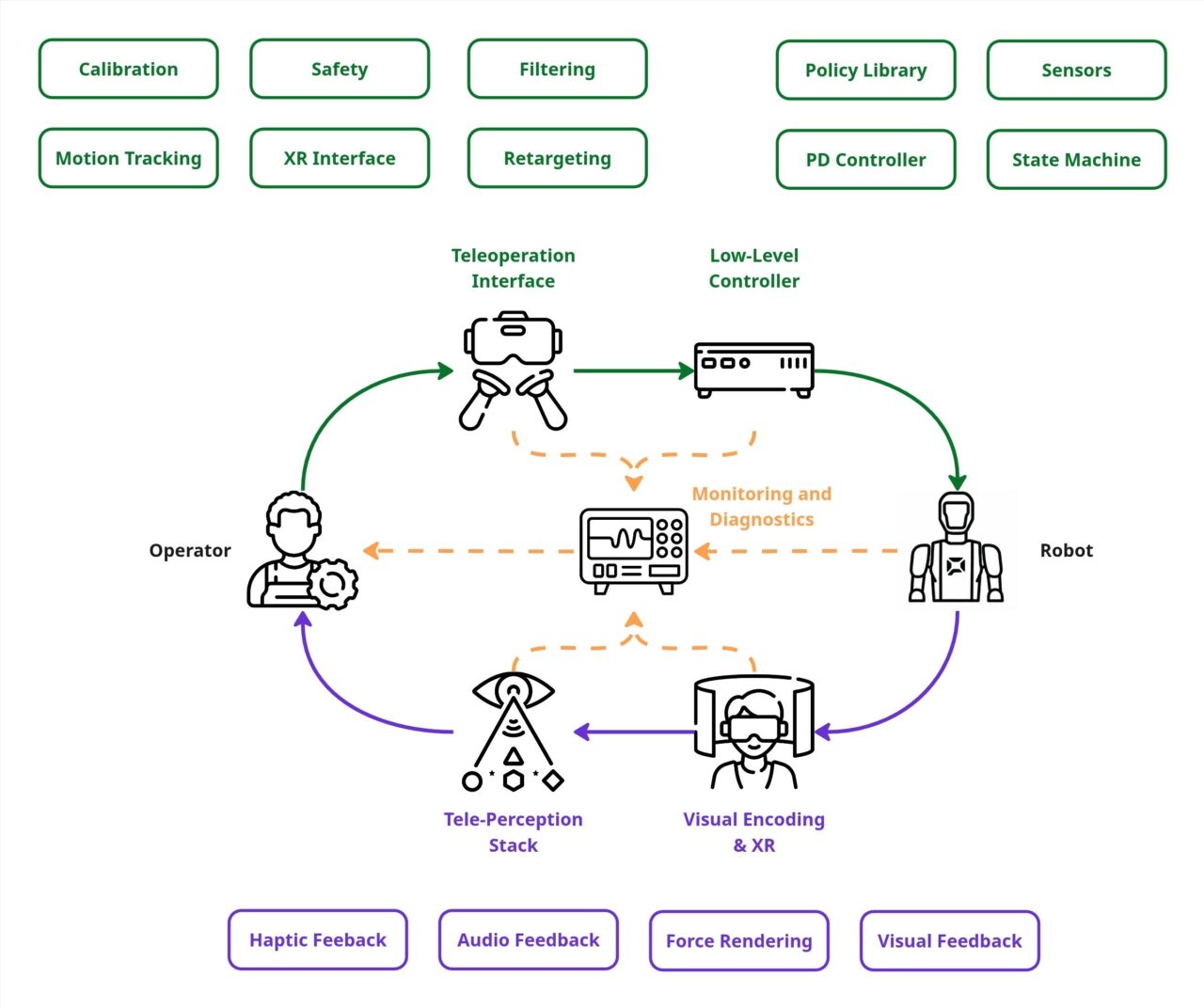
The traditional industrial teleoperation interface is brutal to use, a trained specialist hunched over a pendant or gamepad, nudging one joint at a time, thinking in the robot’s coordinates instead of the task. It’s slow, it’s fragile, and it takes an expert driver. Ours is the opposite. You move the way you’d move to do the job, and motion capture carries that onto the robot. You don’t thumbstick the robot around the floor either, you set your walking speed with a locomotion twister and the robot handles the gait itself. XR cues layered into your view show you what the robot sees and where its limits are. Balance, footing, and situational awareness are all handled by the robot. The effect is that you stop feeling like you’re driving a machine at arm’s length and start feeling like the robot’s body is your body.
Feel matters here in a way it never does for a home robot.
A good weld is about much more than where the torch sits in space. Grinding a casting flush, or seating a heavy part into a tight fixture is pure force regulation. Push too little and nothing happens, push too hard and you gouge the work or jam the fit. These are tasks a human does by feel. Today we close that loop visually, camera video streams over a latency-optimized pipeline, plus the balance and stability cues an operator needs to work near hot metal on uneven footing. Where we’re taking teleoperation is bilateral: reflecting the robot’s contact forces onto the operator’s body, so touch becomes part of the loop.
Teleoperation isn’t a placeholder we’re waiting to switch off.
It’s how the hardest jobs get done today, and every session is on-platform data that pushes our autonomy forward. Consider the development pace: self-driving took the better part of fifteen years to get partway there, with an action space of just acceleration and steering. A humanoid on a factory floor coordinates its whole body and every contact it makes, in a world that’s every bit as unpredictable. In hazardous, safety-critical work, a person who can validate and decide in real time is what gets the job done now. It’s the same reason bomb disposal and hazmat response are teleoperated by necessity, and accepted as such.
General humanoid autonomy is further off than the headlines suggest, and it’s worth being honest about why
The hard part was never a single impressive behavior, but reliability across genuinely novel conditions. We are not betting on a grand general policy that wakes up one day and does everything. We advance autonomy one real task at a time, with teleoperation generating the on-platform data that earns each step. It’s also worth being clear about what a demo reel is and isn’t. Succeeding once on camera says nothing about doing the job on the two-hundredth task of a shift. We optimize for the opposite: repeatability and usability, the metrics that actually decide whether a robot works on a factory floor.
Teleoperation is not a waystation. It’s a foundation.
About Maryam Bandari
Maryam Bandari is a robotics leader with over a decade of experience building robotic systems across industrial, medical, and frontier-technology companies. She holds a PhD focused on classical optimization, and joined Google as a software engineer in 2016 before moving to X, The Moonshot Factory, in 2017 as a founding engineer on an early-stage robotics project that later became Intrinsic. There she built core components of the robotics stack, spanning computational geometry, path planning, and trajectory optimization, and served as tech lead for learning-from-demonstration for robotic manipulation. Her research on learning-based manipulation and deformable-object handling is published in leading robotics venues, alongside patented work in adaptive robot control.
In 2023, she joined Neuralink’s robotics team, developing automated insertion of the brain–computer interface in human patients. Subsequently she joined Johnson & Johnson’s Ottava team to develop the next generation of surgical robots. Both programs achieved major FDA milestones during her tenure.
In early 2026, she joined Persona as the lead for teleoperation and data collection, where she is building the team delivering Persona’s first teleoperation and data-collection platform. Her team is focused on making teleoperation truly immersive, combining state-of-the-art haptic interfaces and rich vision feedback so operators can feel and see through the robot, while embedding shared autonomy that blends human intent with the robot’s own intelligence. The result is a system that both performs dexterous work today and generates the demonstration data needed to train the autonomous robots of tomorrow.
Across industrial automation, brain–computer interfaces, surgical robotics, and teleoperation, her career has centered on one question: how humans can most effectively transfer their skill to machines, whether by demonstration, by shared control, or by data.
Learn more about our solutions.
Contact Us

Persona AI’s vision is to be the labor platform for skilled industrial work. Whether the worksite is a shipyard or a construction zone, Persona AI aims to offer unsurpassed and unparalleled capabilities that will empower human safety.
We are a robotics company. Not an identity verification company.