
Why Humanoids Are Going After Skilled Trades, Not Warehouses
Why skilled industrial labor is the future of heavy industrial humanoids
IEEE Spectrum senior editor Evan Ackerman spent time with Persona AI for a feature on where humanoid robots make economic sense. He spoke with our chief executive, Nicolaus Radford, and our chief technology officer, Jerry Pratt. His conclusion, and ours, is that the answer lies in skilled trades in heavy industry rather than in the consumer and warehouse applications much of the field is currently focused on.
Why skilled trades and not warehouses?
Moving boxes is a solved problem with cheap solutions. The economics only work for a humanoid where the labor is scarce, the work is skilled, and the shortage is holding back production. Welding fits all three. A shipyard, unfortunately, cannot hire its way out of the problem, and every unwelded seam holds up a hull worth millions. Persona AI humanoids are built around tooling use rather than material handling. A robot that can pick things up is useful. A robot that can hold a welding torch and lay a sound weld in arc light and smoke is another thing entirely.
The gap is bigger than most people think
North American and Korean shipbuilding are short somewhere in the region of 40,000 skilled workers between them. Recruitment alone is unlikely to close a gap of that size. The trade is ageing, and the training pipeline behind it has been narrowing for some years.
Why legs, in a place built for people
Shipyards are built around the human body. Ladders, catwalks, hatches, gantries and decks at varying angles. A wheeled system generally needs the site adapted around it. A legged one can take the route a welder already takes. The reasoning behind the form factor is commercial rather than aesthetic. Adapting a yard around a machine is usually more expensive than the machine itself.
What our humanoids do today
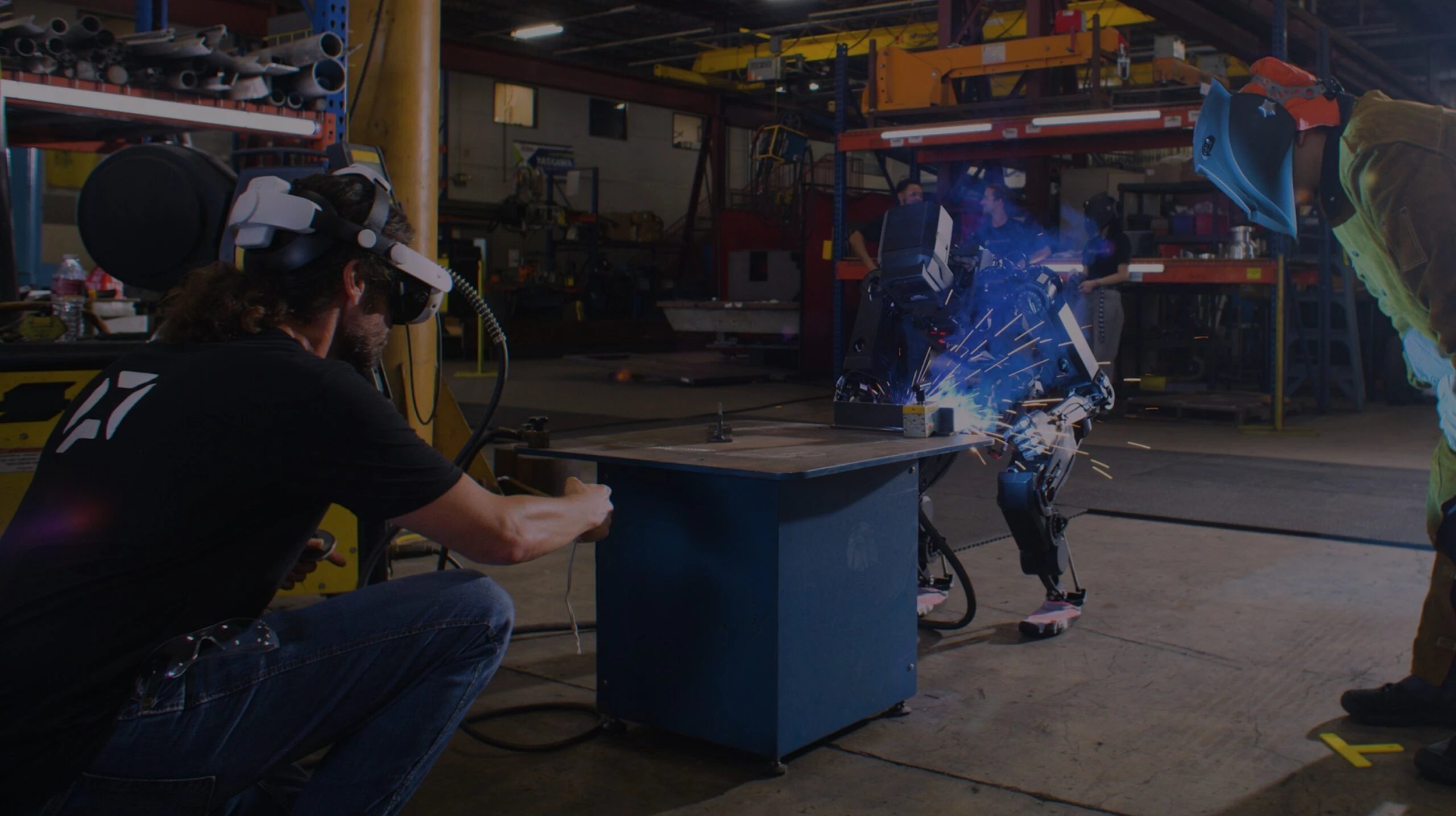
In July, a Gen 2 unit walked to a workstation at ARC Specialties in Houston, squatted, struck an arc and completed a weld, then stood and walked away. There was no gantry, no tether and no fixture, and the sequence was filmed. It was teleoperated, and we think it is worth saying so directly. Every hour an experienced welder spends operating the robot produces training data, and expert demonstration is how the system learns to carry out the work independently. Teleoperation is not a way around autonomy. It is the route to it.
Where this is going into service
We are working with HD Hyundai on welding robots for shipyards, with ABS on the class and safety standards that work has to satisfy, and with POSCO on heavy duty industrial sites. In Louisiana, SSE Steel Fabrication is taking a unit for fillet welding on a production floor. Those are four quite different environments with something in common. In each of them the work is skilled, the people are scarce, and the site was designed around a person.
The article explores how CEO Nicolaus Radford and CTO Jerry Pratt are focusing our humanoid on demanding industrial environments like shipyard welding. Rather than pursuing low-margin “unskilled” labor or consumer applications where economic viability remains elusive, Persona AI is targeting complex tool use and skilled trades where labor shortages severely bottleneck production. Highlighting partnerships with global industrial leaders like HD Hyundai and POSCO, Ackerman details how legged humanoids can navigate unstructured shipyard environments without requiring facilities to be re-engineered, unlocking top-line revenue for shipbuilders and building the foundation for the world’s largest repository of industrial skill.
Read the full IEEE Spectrum feature to explore how Persona AI is bringing economic reality to humanoid robotics.